
01.
THE PROBLEM
CASE IDENTITY // 001
"I found the dataset. Now what?"
Teams could locate data but had no way to tell if it was recent, accurate, or already deprecated. Finding and trusting were two completely different problems.
CASE IDENTITY // 002
“Who owns this? Who do I ask?”
Ownership was scattered. Governance lived in people’s heads, not in the system. When something broke, the first 30 minutes were spent figuring out who to call.
CASE IDENTITY // 003
“I built this pipeline on bad data.”
No lineage visibility meant engineers discovered upstream issues after they’d already shipped downstream. Debugging started with ‘wait, where does this come from?’



FRAGMENTED TOOL ECOSYSTEM
Internal wikis
|
Legacy catalogs
|
Email Chains
|
Slack threads
|
Manual spreadsheets
|
Custom Scripts
150+
10+
0
03.
WHO WE DESIGNED FOR


Technical Data Steward
Teams could locate data but had no way to tell if it was recent, accurate, or already deprecated. Finding and trusting were two completely different problems.
WHAT USERS SAID AND WHAT THEY ACTUALLY MEANT
“Similar sounding words or partial names should still show relevant results.”
Search wasn't fuzzy. Typos meant dead ends.
“I want to know if this data is recent before I use it.”
No freshness indicators. You'd pull a dataset and hope it wasn't six months stale.

Business Data Steward
Ownership was scattered. Governance lived in people’s heads, not in the system. When something broke, the first 30 minutes were spent figuring out who to call.
WHAT USERS SAID AND WHAT THEY ACTUALLY MEANT
“I can't tell where this data came from or what happened to it before it got here.”
Lineage was invisible. Context stopped at the dataset name.

Data Steward Lead
No lineage visibility meant engineers discovered upstream issues after they’d already shipped downstream. Debugging started with ‘wait, where does this come from?’
WHAT USERS SAID AND WHAT THEY ACTUALLY MEANT
“Every domain tracks governance differently. There's no way to compare.”
Governance was happening in 18 different flavours of chaos.
04.
PROBLEM AREAS
Four failures reinforcing one another.
01
Fragmented Data Discovery
Data lived across multiple internal tools. Finding the right dataset meant knowing which tool to check first, and nobody agreed on that.
02
No Data Context
Datasets had names but no story. No lineage, no freshness, no 'here\'s what this actually means and whether you should use it.'
03
Governance by Vibes
Creating and maintaining data assets required manual documentation. Every team had their own process, which is a polite way of saying nobody had one.
04
Search That Doesn't Try Very Hard
No fuzzy matching, no contextual filtering. If you didn't know the exact name of what you were looking for, the system shrugged.
05.
JOURNEY MAP: TECHNICAL DATA STEWARD
0
DISCOVER
EVALUATE
REQUEST ACCESS
USE
MAINTAIN
ACTIONS
PAIN POINTS
EMOTION
Frustrated
Uncertain
Annoyed
Anxious
Defeated
06.
UNDERSTANDING THE ECOSYSTEM
These weren't five separate problems. They were one system pretending to be five.
01
Data Discovery
broken by fragmented tools
02
Metadata Management
broken by incomplete documentation
03
Data Lineage
broken by zero visibility
04
Data Governance
broken by manual processes
05
AI Model Catalog
broken by no connection to data platform
07.
DESIGN SOLUTIONS
Metadata Lifecycle
THE PROBLEM
Data was hard to discover because nobody maintained it properly. Creating a dataset was easy. Keeping it accurate was nobody's job.
WHAT I DESIGNED
Structured creation flows, controlled editing, safe deletion with governance checks, and a business catalog that made browsing actually useful.


KEY DECISIONS
Balanced flexibility with control. Too rigid and nobody fills in metadata. Too loose and the catalog becomes a junkyard.
Data Lineage
THE PROBLEM
Nobody knew where data came from. When something broke, the first question was always ‘what feeds into this?’
WHAT I DESIGNED
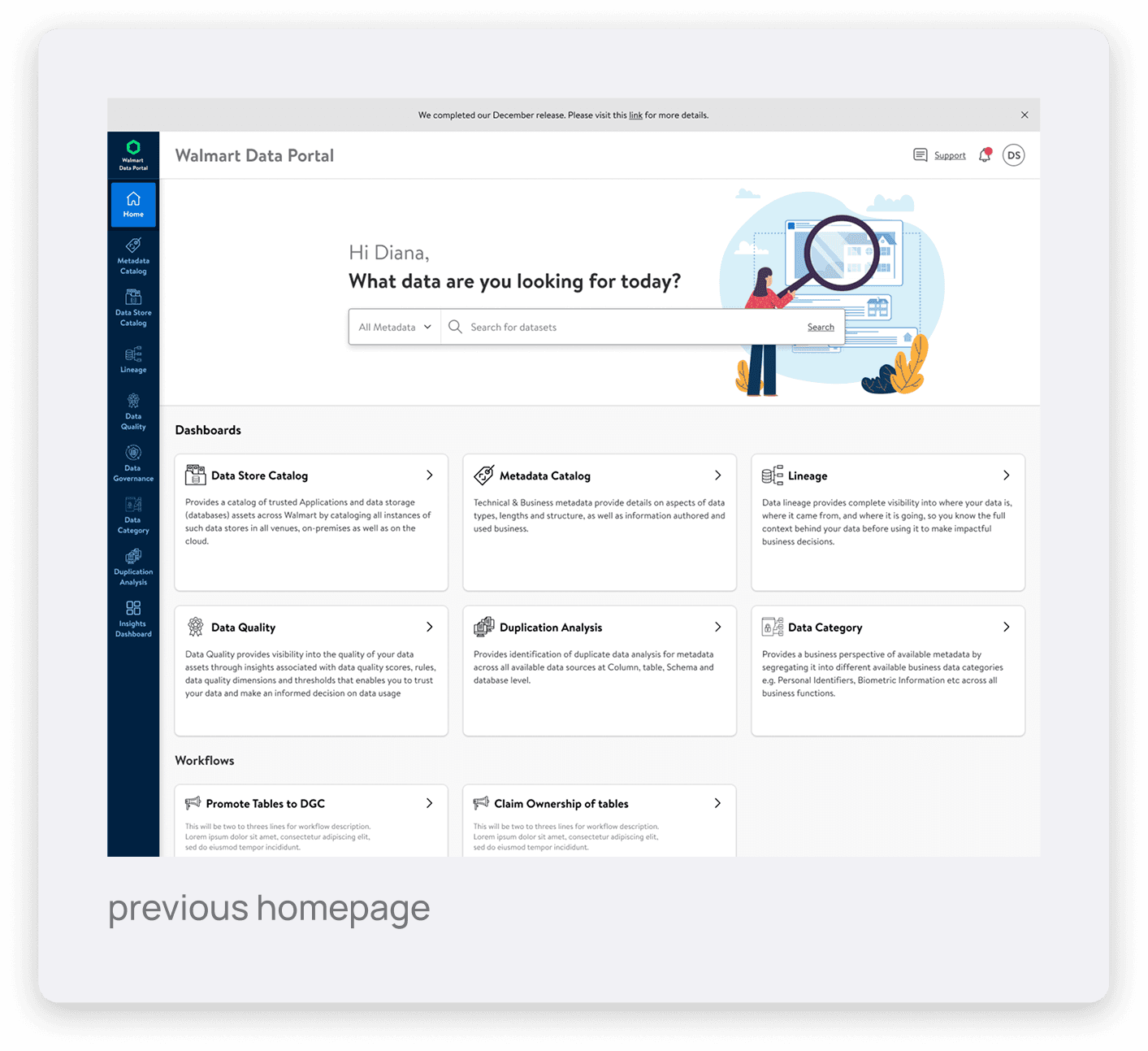
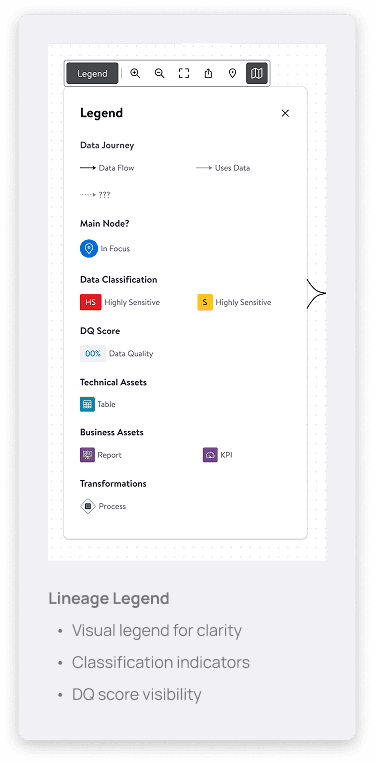
Visual lineage flows showing upstream and downstream dependencies, interactive graph views with zoom and side-drawer inspection panels.
KEY DECISIONS
Simplified complex pipelines into something readable. The decision was to answer one question first: ‘What happens if this breaks?’



AI Model Catalog
THE PROBLEM
ML models existed in a parallel universe from the data platform. Teams were rebuilding models that already existed elsewhere.
WHAT I DESIGNED
A central catalog for AI models with governance metrics, quality indicators, and connections back to the datasets that feed them.
KEY DECISIONS
Extended the platform beyond data into intelligence. This wasn't in the original scope — research showed that the same trust and discovery problem applied to ML assets.


08.
BEFORE / AFTER
BEFORE EDP
Finding data meant checking 4+ tools
Ownership lived in Slack DMs and tribal knowledge
Governance was manual and inconsistent
No lineage. No freshness indicators. No quality scores.
AFTER EDP
One platform for discovery and governance
Clear lineage across upstream and downstream
Structured workflows from creation to lifecycle management
Transparency and trust baked into the system, not bolted on
09.
IMPACT
30%
USER ADOPTION
EDP became the primary platform for enterprise data discovery.
ENHANCED DISCOVERABILITY
AI-powered search improved dataset discovery across Walmart's data ecosystem.
IMPROVED GOVERNANCE
Structured workflows increased metadata completeness and consistency across teams.
10.
WHAT I LEARNED
Four things this product taught me.
01
Complex systems reward patience
Jumping to solutions is tempting. Understanding how 18 domains actually work together is slower and infinitely more useful.
02
Internal tools power real work
No app store rating. No Product Hunt launch. Just people who use this thing 8 hours a day and notice immediately when you get something right.
03
Good design is a team sport
The best decisions came from sitting with engineers, PMs, and governance leads and understanding their constraints before proposing anything.
04
Iteration isn't a phase, it's everything
Every round of feedback surfaced edge cases we couldn't have predicted. The platform got better because we kept going back.
Other works
View all works

Walmart Homepage Redesign
Using product data, research, and AI-native prototyping to rethink how the Walmart Africa homepage drives discovery and cart action.